Propiconazole: Uses, Health Effects, Safety and Regulation

Propiconazole is a systemic foliar fungicide in the DMI triazole class. It works by interfering with ergosterol biosynthesis in fungi and is used for turf and ornamental disease control. It is toxic to people mainly by the oral route and has no carcinogenicity classification from regulators. It persists in the environment, with half-lives of 45 and 51 days. It is toxic to aquatic life only at high concentrations. The EPA has issued an eligibility decision, but the EU review records critical areas of concern. Drinking water is allowed up to 0.1 mg/L, and the acceptable daily intake is 0.04 mg/kg bw per day. To use it more safely, wear chemical-resistant gloves and protective clothing.
What Is Propiconazole?
Propiconazole is a systemic foliar fungicide in the DMI triazole class of chemicals. Propiconazole has the IUPAC name 1-[2-(2,4-dichlorophenyl)-4-propyl-1,3-dioxolan-2-ylmethyl]-1H-1,2,4-triazole. Its major metabolites are 1,2,4-triazole, triazole alanine and triazole acetic acid. The 2014 EPA product label acceptance letter for registration 083851-00010 lists propiconazole for disease control in crops, turf and ornamentals.
How Does Propiconazole Work?
Propiconazole works by interfering with ergosterol biosynthesis in fungi. Propiconazole acts as a demethylation inhibitor of sterol biosynthesis in the membranes of fungi. Without ergosterol, fungal cellular growth stops. The target is therefore the sterol pathway in the fungal membrane. In 2011, Garrison, Avants and Miller examined propiconazole stereoisomer loss in soil slurries. They described the compound as a systemic foliar fungicide. Isomers with absolute configuration 2S inhibit ergosterol biosynthesis more efficiently than the 2R isomers.
What Is Propiconazole Used For?
Propiconazole is used for turf and ornamental disease control. Propiconazole treats crops such as wheat, barley and grapes (EU residue trials). Propiconazole serves biocidal products of product type 8 (Norway). The European Food Safety Authority (EFSA), the EU food safety agency, required residue trials on wheat and barley. Propiconazole was the main component of the total radioactive residues in grapes. The 2006 EPA Reregistration Eligibility Decision documents the registered uses in the United States.
How Toxic Is Propiconazole to People?
Propiconazole is toxic to people mainly by the oral route, with moderate acute oral toxicity in rats. Propiconazole has low dermal and inhalation toxicity and is a skin sensitiser, not a skin or eye irritant. Rats are the most sensitive species in the long-term studies. The short-term oral no observed adverse effect level is 2.7 mg/kg bw per day in a 17-week mouse study. The 2017 EFSA Journal pesticide risk assessment of the active substance propiconazole sets that level. The systemic acceptable operator exposure level is 0.1 mg/kg bw per day. It rests on parental toxicity in a two-generation rat study. A 2017 study by B S Paul in the Journal of postgraduate medicine describes a young woman. She developed generalized chorea after propiconazole toxin ingestion. Human evidence therefore rests on that single case, while the dose limits come from animal studies.
What Health Effects Does Propiconazole Cause in the Liver?
Propiconazole causes liver effects in rats and mice, because the liver was the target organ in short-term oral studies. Mice showed increased liver weights and changes in blood plasma enzymes at 50 mg/kg bw/day. Rats were the more sensitive of the two species. The long-term no observed adverse effect level is 3.6 mg/kg bw per day in rats. In mice it is 10 mg/kg bw per day. Liver weight, blood plasma enzymes and liver lesions measure these effects. The EPA reregistration toxicity table reports increased liver lesions. A 2025 study by Francesca De Battistis in Frontiers in endocrinology reports that propiconazole can activate hepatic nuclear receptors. That activation contributes to steatosis.
Does Propiconazole Affect Reproduction or Development?
It depends. Propiconazole affects reproduction and development only at higher dose levels than those producing parental toxicity. The parental no observed adverse effect level is 8.4 mg/kg bw per day in a two-generation rat study. The reproductive and offspring level in that study is 43.7 mg/kg bw per day. A 2017 study by Milene Leivas Vieira in Toxicology gave male rats 4 mg/kg and 20 mg/kg. The doses spanned the F1 and F2 generations. That chronic exposure produced behavioural and reproductive changes. In 2017, the European Food Safety Authority (EFSA) noted that propiconazole may have endocrine disrupting properties. The agency treats this as a critical area of concern, so the endocrine question stays open.
What Symptoms Does Propiconazole Exposure Cause?
Propiconazole exposure causes skin rash, itching, skin irritation and respiratory effects such as difficulty breathing. These symptoms of propiconazole exposure come from the EPA reregistration decision. The key symptoms include:
- Skin rash: Skin rash is a skin symptom reported after exposure. Propiconazole is a skin sensitiser, which fits this skin response.
- Itching: Itching is a skin symptom reported after exposure. The EPA decision lists it with rash and skin irritation.
- Skin irritation: Skin irritation is a skin symptom reported after exposure. Acute studies call propiconazole not a skin or eye irritant, so these reports describe exposure experience, not a classified hazard.
- Respiratory effects: Respiratory effects such as difficulty breathing were part of the reported exposure symptoms. Acute inhalation toxicity is low in animal studies.
A study by B S Paul in the Journal of postgraduate medicine shows how severe the symptoms can become. The study describes generalized chorea after propiconazole toxin ingestion. The brief gives no dose figures for these symptoms, so the dose limits sit in the toxicity sections above.
Is Propiconazole Carcinogenic?
No. Propiconazole carries no carcinogenicity classification from the regulators that reviewed it. Propiconazole is classed by the EPA as not classified for potential carcinogenicity. The European Chemicals Agency (ECHA), the EU chemicals agency, reviewed the mouse liver tumours through its Risk Assessment Committee. That committee found the tumours not of concern for humans and no carcinogenicity classification warranted. Propiconazole induced liver tumours in male CD-1 mice at 107.8 and 344.3 mg/kg bw per day. A review describes propiconazole as a mouse hepatocarcinogen with a mechanism of carcinogenic action, which is the disputed point.
How Long Does Propiconazole Persist in the Environment?
Propiconazole persists in the environment for a long time, with a half-life of 45 and 51 days. Those values describe loss from the water phase of two soil slurries. Propiconazole is classed as moderately persistent in soil. The slurries were aerobic, spiked at 50 mg/L and followed over five months. No loss of propiconazole was observed from the autoclaved controls of either soil. The EU peer review identified data gaps for ground and surface water exposure assessment, so water persistence remains uncertain.
How Toxic Is Propiconazole to Aquatic Life?
Propiconazole is toxic to aquatic life only at high concentrations, with a 96-hour LC50 above 100 mg/L. That value applies to the Chinese mitten crab. Propiconazole showed low acute toxicity to Eriocheir sinensis, the Chinese mitten crab studied in the rice-crab field. In 2022, Frontiers in Environmental Science published residue monitoring of propiconazole in the rice-crab co-culture field. That work found the highest bioaccumulation in the gills, followed by the hepatopancreas and the meat.
Is Propiconazole Regulated by the EPA?
Yes. Propiconazole is regulated by the EPA, which has issued an eligibility decision for it. The 2006 EPA Reregistration Eligibility Decision for Propiconazole (EPA 738-R-06-027) is the decision that governs the compound. Labels state that all requirements of that decision have been satisfied for accepted labelling. The 2015 EPA human health assessment docket EPA-HQ-OPP-2015-0459 reviews exposure for the Worker Protection Standard and re-entry intervals. Label statements on personal protective equipment and the restricted entry interval reduce risk.
Is Propiconazole Approved in the European Union?
It depends. Whether propiconazole is approved in the European Union rests on a review that records critical areas of concern. The European Chemicals Agency (ECHA) proposed a reproductive toxicity category 1B classification, which creates one critical area of concern. The European Food Safety Authority (EFSA) peer review of 2017 treats groundwater metabolites as relevant to the approval. Norway’s 2023 note concerns the renewed approval of propiconazole in product type 8 biocidal products. The unresolved points in the EU assessment are the concern areas the review lists.
How Much Propiconazole Is Allowed in Drinking Water?
Propiconazole is allowed in drinking water up to 0.1 mg/L, the health-based guideline value for long-term exposure. The Australian guideline allows propiconazole at that level and bases it on long-term effects. The guideline uses 2 L/day as the estimated maximum amount of water an adult drinks. Minor excursions above the guideline would need to occur over a significant period to be a health concern. A 2020 study by Nurulizani Elfikrie in The Science of the total environment found 86% removal of propiconazole. The plant was a conventional drinking water treatment plant.
What Reference Doses Do Regulators Set for Propiconazole?
Regulators set the acceptable daily intake of propiconazole at 0.04 mg/kg bw per day. Propiconazole has an acute reference dose of 0.1 mg/kg bw, derived from developmental toxicity. The daily intake rests on the long-term rat no observed adverse effect level of 3.6 mg/kg bw per day. The 2006 EPA reregistration table lists 0.3 mg/kg/day as the acute RfD for propiconazole. The EPA acute value is higher than the European acute value, so the reference doses differ across regulators. The daily intake uses the 2-year rat study as its basis. The European Food Safety Authority (EFSA) review assessed the representative use as a fungicide on wheat and barley.
How Can People Use Propiconazole More Safely?
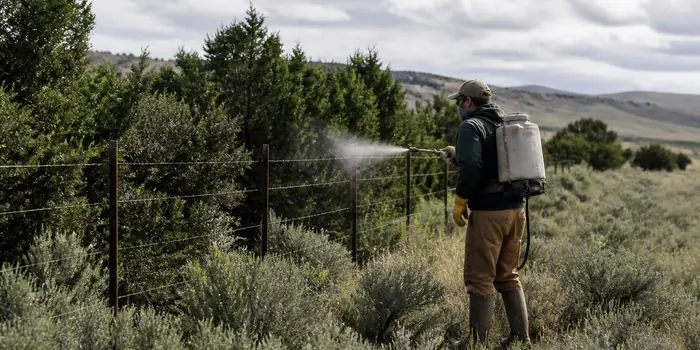
To help people use propiconazole more safely, wear chemical-resistant gloves and protective clothing. Wash the outside of gloves before removing them after handling propiconazole. Keep workers out of treated areas during the restricted entry interval. Follow the label PPE statements.
A 2008 study by Sheila Flack in the Journal of environmental monitoring monitored five farm workers. They prepared and applied pesticide to peach crops. Dermal exposure ranged from non-detectable to 32.1 +/- 22.6 ng per microg keratin. Breathing-zone concentrations varied from 0.2 to 2.2 microg/m3. The 2015 EPA docket assesses occupational post-application risk for propiconazole.
What Protective Equipment Is Needed When Using Propiconazole?
The protective equipment needed when using propiconazole is chemical-resistant gloves, a long-sleeved shirt with long pants, and shoes with socks. The propiconazole label letter from the EPA lists these items in its PPE statements. Key items include:
- Chemical-resistant gloves: Chemical-resistant gloves are listed among the label protective equipment statements. Wash the outside of the gloves before removing them.
- Long-sleeved shirt and long pants: Long sleeves and long pants cover the skin. They reduce skin exposure during handling.
- Shoes and socks: Shoes and socks cover the feet. They are the third item in the label statements.
A 2014 label states that PPE must come off immediately after handling the product. The EPA reregistration decision lists respirator use as a personal protective measure.
How Long Must People Stay Out of Propiconazole-Treated Areas?
People must stay out of propiconazole-treated areas for 12 hours under the restricted entry interval on the EPA label. Propiconazole labels bar worker entry into treated areas during that interval. The EPA Human Health Division would recommend a restricted entry interval of 24 hours for some uses. The interval depends on the product and its skin or eye irritation class. A 2018 study by Richard Latin in Plant disease tracked fungicide residues on creeping bentgrass over 42 days after application.