Pesticide Drift
Pesticide drift is the airborne movement of pesticide dust or droplets from an area of application to any unintended site. It has four groups of causes. Fog-size droplets of 5 micrometers can travel 3 miles in a 3 mph wind. The health effects range from low-severity illness to severe poisoning. Drift also causes five kinds of environmental and economic losses. It is prevented by careful steps before and during spraying. Applicators are legally responsible, even when weather is the true culprit. To report a suspected case, start with your state pesticide regulatory agency.
What Is Pesticide Drift?
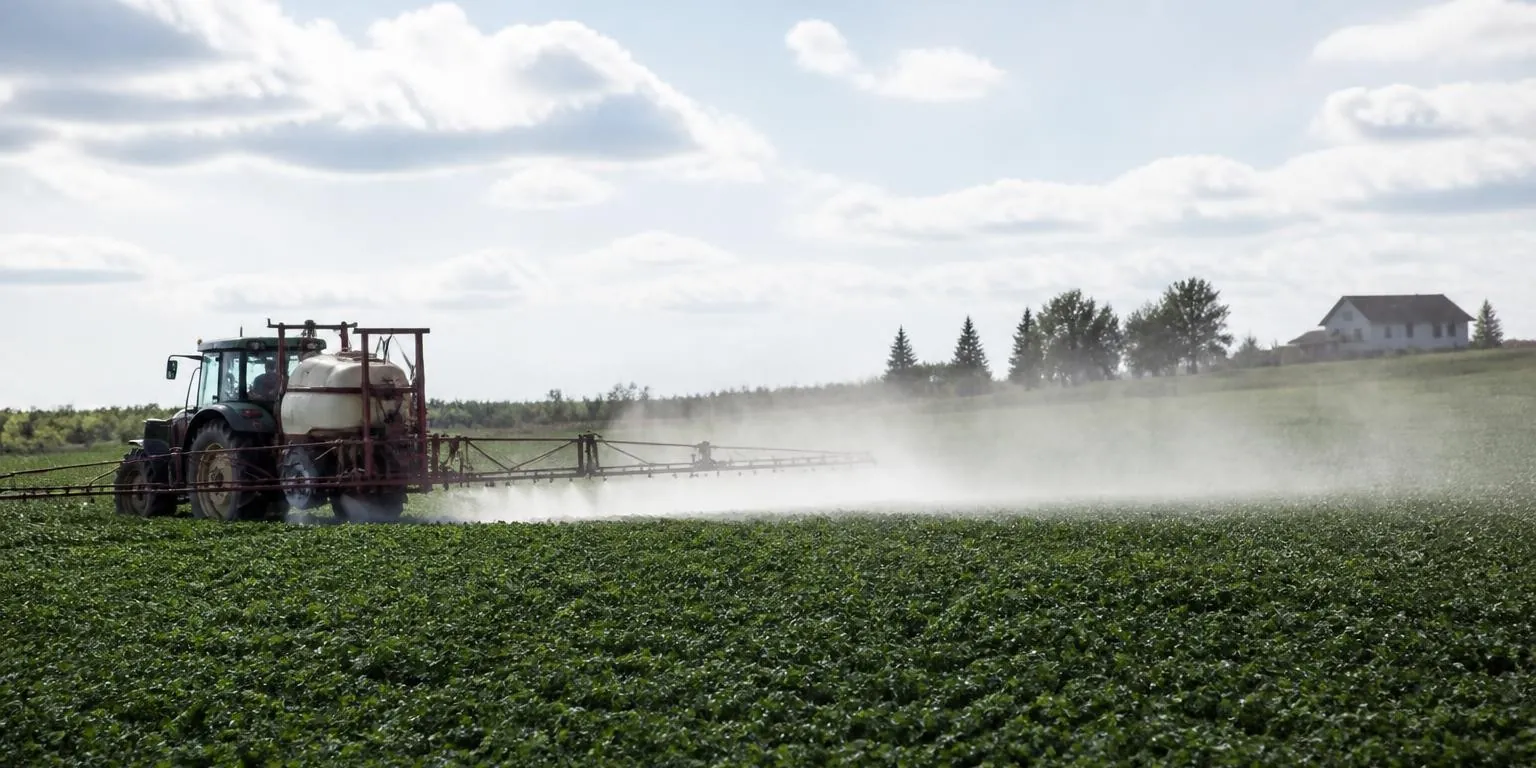
Pesticide drift is the airborne movement of pesticide dust or droplets from an area of application to any unintended site. Pesticide drift happens at the time of application or soon after, when some chemicals become vapors that move off-site.
Pesticide drift usually occurs during or directly after an application, but it can take place hours or days later. Spray nozzles on application equipment produce the droplets, used on crops, forests, turf and home gardens. Some pesticides drift as vapor after application even when applied as a solid or liquid.
Pesticide drift can cause accidental exposure to people, animals, plants and property. EPA estimates up to 70 million pounds of pesticides are lost to drift each year. EPA is actively engaged in several initiatives to help minimize pesticide drift problems.
What Are the Types of Pesticide Drift?
The types of pesticide drift are spray drift, vapor drift and particle drift. Each type of pesticide drift moves active ingredients off target in a different form. Key types include:
- Spray drift: Spray drift moves liquid pesticide droplets through the air and lands them off the intended site, from hand sprayers to aerial applications. It is the most common type of drift and small driftable fines worsen it.
- Vapor drift: Vapor drift occurs when a pesticide volatilizes from a liquid or solid into a gas and moves offsite with air currents. Vapor pressure is an important factor and appears to have a major effect on volatilization. High temperatures and low humidity increase volatilization, and volatility of some products increases as temperatures rise into the upper 80s and 90s.
- Particle drift: Particle drift carries pesticide active ingredients on solid particles such as granules, dust or contaminated soil.
2,4-D ester is highly volatile and should not be used when temperatures are high. 2,4-D amine has low volatility and suits a wider range of conditions. Dicamba is known to easily volatilize and travel far off site through vapor drift if used improperly. The ecological risks associated with dicamba drift and volatility are real. In 2017, off-target dicamba movement damaged an estimated 2.5 million acres of soybeans and cotton.
NPIC and UNL call droplet movement particle drift. MSU Extension calls droplet movement spray drift and reserves particle drift for solid particles.
What Causes Pesticide Drift?
The main causes of pesticide drift are four factor groups. Spray characteristics, equipment and application technique, weather at application, and operator care, attitude and skill influence drift. Pesticide drift depends on equipment design, droplet or particle size, weather conditions, and other factors.
45% of drift illness cases came from soil applications with fumigants, which were responsible for the largest percentage. Aerial applications accounted for 24% of drift illness cases. The 2,945 cases came from 11 US states between 1998 and 2006. Common factors in drift cases included weather conditions, improper seal of the fumigation site, and applicator carelessness near nontarget areas. Chloropicrin is regulated in the United States by the Environmental Protection Agency as a restricted use pesticide.
Spray drift reaches its highest potential when it is hot and dry. Under extremely hot and dry conditions, evaporation rapidly decreases droplet mass, which increases drift distance.
The Ohio Department of Agriculture investigates drift as about half of all its non-compliance cases. Complete elimination of spray drift is impossible, but managing the major factors reduces problems significantly. A Spray Drift Task Force shares the cost of building a generic spray drift data base. The data base serves product registrations in the United States and Canada. EPA focuses on wind speed limits, spray droplet size, spray release height and buffer zones when reviewing product registrations.
How Does Wind Speed Affect Pesticide Drift?
Wind speed affects pesticide drift because the risk of spray drift increases as the wind picks up. No wind speed number guarantees safety, but wind speeds of 3 to 7 mph are generally preferable. Spraying is not advised when wind speed exceeds 10 mph.
Wind speeds below 5 mph, with other good management practices, significantly reduce drift injury. The 2026 dicamba label requires application when wind speed is between 3 and 10 mph. That range is strong enough to prevent inversions but not so strong as to cause excessive drift. New phenoxy herbicide formulations, including Enlist Duo, XtendiMax, Engenia and FeXapan, carry new application requirements. EPA reviews minimum and maximum wind speed as one of four main drift factors.
Wind direction determines buffer distance from sensitive sites, with less distance needed if wind blows away from them. If the wind blows toward sensitive downwind crops, spraying stops and resumes when the wind shifts away. Wind speed and direction are measured before, during and after an application.
How Do Temperature Inversions Cause Pesticide Drift?
Temperature inversions cause pesticide drift because cooler denser air at the surface sits under warmer air. This creates stagnant conditions with no or lateral air movement. A temperature inversion leaves spray droplets undispersed, in a concentrated mass that moves with any subtle airflow. Applying pesticides during a temperature inversion can result in damaging, long distance drift.
Fine droplets of 200 microns or less hang in the air instead of settling. These droplets can move miles off-site when winds rise later in the day. Inversions typically start at dusk and break up with the sunrise because of vertical air mixing.
An inversion is present if air at 8 to 10 feet is warmer than air at 6 to 12 inches. Both heights are above the soil. A shaded thermometer measures both heights. Smoke or dust that hangs in the air without dissipating suggests an inversion. Fog hanging in the air may indicate an inversion. Signs include wind under 3 mph, few clouds, low humidity, and dew or frost.
How Does Droplet Size Affect Pesticide Drift?
Droplet size affects pesticide drift because small droplets take more time to fall to the ground and can drift farther. Bigger droplets fall faster, so they are less likely to drift with the wind. Larger droplets reduce drift when compared with finer droplets.
ASABE standard S-572.1 classifies droplets from extremely fine to ultra coarse, based on measurement in microns. Volume median diameter is the most widely used parameter of droplet size. It splits a spray sample by volume. Half the volume holds droplets smaller than the median, and half holds larger ones.
Nozzle pressure sets droplet size, because lower spray pressure allows larger droplets. One nozzle can give medium droplets at low pressure and fine at high pressure. Lowering the spray pressure reduces driftable fines. Nozzle choice directly affects the size of the spray droplet, and the label may require coarse or medium droplets. The Turbo TeeJet and AIXR TeeJet nozzles from Spraying Systems Co. are examples of such nozzles.
Boom height links to drift potential, since the higher the boom, the higher the drift potential. Nozzle output must be within 5% of the manufacturer’s rating. Extended range flat fan nozzles operate at 15 to 60 psi. Contact herbicides, insecticides and fungicides can be less effective if applied in a coarse-sized droplet. Systemic herbicides such as glyphosate suit coarse droplets because they do not require thorough coverage.
How Far Can Pesticide Drift Travel?
Pesticide drift can travel 3 miles, as far as fog-size droplets of 5 micrometers move in a 3 mph wind. Fog-size droplets travel farthest because they fall slowest. Pesticide drift from a 20 micrometer very fine droplet reaches 1100 feet in the same wind.
A 5 micrometer fog-size droplet takes 66 minutes to fall 10 feet. A 20 micrometer very fine droplet takes 4 minutes. A 100 micrometer fine droplet travels 44 feet and falls 10 feet in 10 seconds. A 240 micrometer medium droplet travels 28 feet and falls 10 feet in 6 seconds. A 400 micrometer coarse droplet travels 8.5 feet and falls 10 feet in 2 seconds. A 1000 micrometer extra coarse droplet travels 4.7 feet and falls 10 feet in 1 second.
Temperature inversion drift moves suspended droplets miles off-site when winds increase later in the day. Pesticide drift can take place hours or days later. Droplet width is given in micrometers, fall time in minutes or seconds, and travel distance in feet or miles.
A 2025 study by Saeed S Albaseer at Goethe University Frankfurt found up to 25% of pesticides ride air currents. Those applied pesticides can travel hundreds or thousands of kilometers.
AgDRIFT, the spray drift model derived from the earlier drift model AGDISP, allows for simulation of drift distances.
What Are the Health Effects of Pesticide Drift?
The health effects of pesticide drift range from low-severity illness to severe poisoning. Drift exposure reaches nearby homes, schools and playgrounds. Wind-carried sprays and dusts deposit on farm workers in adjacent fields. Key effects include:
- Low-severity illness: Most drift illness cases are of low severity. In 11 US states from 1998 to 2006, 92% of 2,945 drift illness cases were low severity, and 47% of drift illness cases were exposed at work.
- Symptom reports: Residents near sprayed cotton fields reported more acute and chronic symptoms than controls. In a Nicaragua community study of 100 residents aged 10 or older per community in the 1990 cotton season, 87% of residents of the exposed community reported one or more symptoms, against 53% of controls. The authors state the study should be replicated with more quantitative exposure measures.
- Cholinesterase suppression: Cholinesterase activity marks absorption of organophosphate-type pesticides in residents. Mean cholinesterase activity was significantly lower in the sprayed community, 4.9 versus 5.3 IU/dl.
- Severe poisoning: Severe poisoning is rare in surveillance data. The Earlimart pesticide poisoning refers to a November 13, 1999 pesticide drift event in the vicinity of a community in the middle of the San Joaquin Valley.
Who Is Most at Risk From Pesticide Drift?
The most at risk from pesticide drift are agricultural workers and residents of agricultural regions. Children in farming areas, school students and employees and pets follow. Agricultural workers rank first at 114.3 cases per million person-years. Residents of five California counties follow at 42.2.
Agricultural workers and residents in agricultural regions had the highest rate of pesticide poisoning from drift exposure. Incidence of drift illness was 0.79 for other workers. 14% of drift illness cases were children under 15. Pesticide drift can pose health risks to pets at homes, schools and playgrounds.
31% of school cases with a known source were drift from farmland. That is 125 of 406 cases with detailed source information. Pesticide spray buffer zones around schools and practices to reduce drift are recommended.
The CHAMACOS Study is the longest running longitudinal birth cohort study of pesticides among children in a farmworker community. It has spearheaded almost 150 publications. Children in agricultural areas may be exposed to higher pesticide levels. Tracked-in pesticides, drift, breast milk from farmworker mothers and play in nearby fields all add exposure.
The Worker Protection Standard offers occupational protections to over 2 million agricultural workers and pesticide handlers. These workers labor at over 600,000 agricultural establishments.
What Are the Environmental and Economic Effects of Pesticide Drift?
The environmental and economic effects of pesticide drift include five losses. These are crop damage, water contamination, harm to wildlife, wasted product and investigation costs. Pesticide drift harms non-target plants, insects, fungi and other organisms near and far from application sites. Key effects include:
- Crop damage and unsellable crops: Crops on nearby farms can become unsellable if the drifting pesticide is not registered for use on the crop. In 2017, more than 2.5 million acres were estimated damaged from off-target dicamba movement. A peach grower with a 1,000-acre orchard was awarded $265 million in damages from chemical manufacturers.
- Water contamination: Drift can contaminate water bodies, affecting drinking water, aquatic organisms and fish. It can cause a reduction in pollinator health and contamination of surface water.
- Harm to wildlife and pollinators: Wildlife and pollinators sensitive to certain pesticides can be harmed by drift. The long-term scale of that harm is still unclear.
- Wasted pesticide product: EPA estimates up to 70 million pounds of pesticides are lost to drift each year.
- Investigation costs: State and local agencies receive thousands of complaints about drifting pesticides each year. They spend substantial resources investigating drift complaints.
A 2021 study by B Strandberg from Aarhus University found glyphosate drift cut flower numbers of two non-target species. Maximal glyphosate deposition was 30 g glyphosate/ha, which is 2.08% of the 1440 g a.i./ha label rate.
A 2025 study titled Beyond the field: How pesticide drift endangers biodiversity links drift to plant losses. Drift is linked to over 50% reductions in wild plant diversity within 500 m of fields. Long-term consequences of airborne pesticides on biodiversity remain poorly understood.
The Kern County Agricultural Commissioner’s Office found that a pesticide drifted onto a nearby pistachio site and damaged the trees. In December 2021, EPA released a summary of dicamba-related incident reports from the 2021 growing season. The Center for Food Safety describes itself as protecting the earth from industrial agriculture through legal, scientific, and grassroots action.
How Can Pesticide Drift Be Prevented?
Pesticide drift is prevented by careful steps before and during spraying. To prevent pesticide drift, follow the 6 steps below, starting with the pesticide label.
- Read the pesticide label first, because reading the label is the first and most important way to minimize risk and exposure. Many labels carry a section titled Precautions for Avoiding Spray Drift, and EPA reviews wind speed, spray droplet size, spray release height and buffer zones.
- Assess the site and notify neighbors before spraying. A pre-spray evaluation covers wind pattern, topography, distance to houses, adjacent crops, streams and bees. Notify neighbors in time to protect workers and crops, and consider registering with one of the registries in FieldWatch.
- Check wind, temperature and inversion before each application. Spray in the morning when there is no inversion, in calm weather, with wind speed between 3 and 10 mph. Keep current and forecasted temperatures below 85 degrees Fahrenheit to reduce volatilization of almost all products, and choose a low-volatility pesticide to cut vapor drift.
- Choose low-drift nozzles with lower pressure and boom height. Lowering boom height reduces drift potential, and shielded spray equipment can reduce drift up to 70% if used properly. The Drift Reduction Technology program encourages labels that tell applicators to use DRT-rated technologies, and the Turbo TeeJet and AIXR TeeJet are nozzle examples.
- Leave buffers around sensitive sites and spray these areas first before afternoon winds pick up.
- Stop spraying when conditions change. If wind speed or direction changes during an application, adjust the buffer or stop the application.
How Do Low-Drift Nozzles Reduce Pesticide Drift?
Low-drift nozzles reduce pesticide drift by producing larger droplet sizes with fewer driftable fines. Low-drift nozzles can reduce drift 50 to 90 percent compared with a conventional flat fan nozzle, depending on design.
Chamber design nozzles operate at 15 to 90 psi and give medium to extremely coarse droplets. Venturi nozzles insert air into the liquid spray droplets to increase overall droplet size. Most venturi nozzles operate at 40 to 100 psi and give coarse to ultra-coarse droplets.
The Turbo TeeJet can reduce drift by 50% compared to the extended range flat fan nozzle. Extended range flat fan nozzles are not low-drift because of abundant driftable fines. The Drift Reduction Technology program encourages the manufacture, marketing, and use of spray technologies verified to significantly reduce pesticide drift.
Low-drift nozzles suit systemic herbicides such as glyphosate that do not need thorough coverage. Switching to low-drift nozzles may not be possible with many contact pesticide formulations that need smaller droplets. Nozzles with coarser droplets have low coverage.
Do Drift Retardants Prevent Pesticide Drift?
No. Drift retardants do not prevent pesticide drift in full, because they reduce driftable fines without eliminating all drift. Drift retardants are adjuvants, usually polymers, that increase the viscosity and density of the spray mixture and produce larger droplets.
Drift retardants bind ultra-small spray particles into larger droplets, which reduces drift risk and maximizes pesticide performance. Their performance is variable and not as effective as other drift reduction methods. Some drift adjuvants heighten droplet movement with certain low-drift nozzles, so the product specification sheet must be checked.
Drift retardants are the last defense after better targeting and low-drift nozzles. They should not be solely relied on.
How Can Homeowners Prevent Pesticide Drift?
To prevent pesticide drift, homeowners start with applying the pesticide only directly to the treatment area. Keep the wand or hose as close as possible to the target during home application. Choose calm weather and apply when rain is not predicted for the next 24 hours. Direct sprays away from property lines, and talk to the neighbor before treating a tree near the boundary. Check the label, which may prohibit applications under certain weather conditions, using high-pressure sprays or using certain nozzles.
Home application near water needs care. Mind storm drains, drainage ditches, gutters and surface waters during application. Rinse application equipment over the treated area, and sweep granules from hard surfaces back onto the lawn or garden. Follow the watering-in instructions on the label without watering to the point of runoff.
Who Is Responsible for Pesticide Drift?
Applicators are legally responsible for pesticide drift problems, even when weather is the true culprit. The pesticide applicator must recognize conditions conducive to drift and vulnerable areas before an application.
The Federal Insecticide, Fungicide, and Rodenticide Act authorizes the EPA to regulate the distribution, sale and use of pesticides. It is often illegal to apply pesticides in a manner that allows them to move off-site. A person responsible for pesticide drift who causes non-target impacts is liable. A peach grower was awarded damages from chemical manufacturers.
The Oregon Department of Agriculture informs users of their legal duty under the Oregon Pesticide Control Law (ORS 634). It enforces that law. It helps educate pesticide users on how to avoid direct drift and volatilization. The Pesticide Drift Exposure Response Act, or SB 391, is a California act that was passed in 2005. Ohio shows the weight of this duty. Drift accounts for about half of the non-compliance cases its Department of Agriculture investigates.
A radius of 25 feet for some applications and 100 feet for others defines the application exclusion zone. The radius depends on application type and droplet size. Handlers must suspend an application if workers or other people are in that zone. EPA’s Agricultural Worker Protection Standard aims to reduce pesticide poisonings and injuries among agricultural workers and pesticide handlers.
How Is Pesticide Drift Reported?
To get pesticide drift reported, start with your state pesticide regulatory agency, the contact for a suspected case. Contact the National Pesticide Information Center (NPIC) at 800-858-7378 to report pesticide drift problems. Seek medical advice from a physician, poison control center or health department for health questions. File a written complaint within 45 days if you lost crops or damaged vegetation. Allow the inspector to visit and take samples, then wait for the enforcement decision.
The Minnesota Department of Agriculture requires a written complaint within 45 days for lost crops or damaged vegetation. An inspector may visit within 1 to 2 business days. Samples take two to three weeks to analyze, and results go to the complainant. Enforcement action is determined within 6 to 8 months of the complaint. The Minnesota Department of Agriculture receives approximately 150 pesticide-related complaints per year.
FieldWatch, including DriftWatch and BeeCheck, lets growers mark sensitive sites on a map for applicators. DriftWatch is a voluntary and free registry. It improves communication between specialty, organic and conventional row crop producers and pesticide applicators.
California’s 55 agricultural commissioners investigate pesticide violations. They partner with the California Department of Pesticide Regulation to enforce pesticide use laws. The California Department of Pesticide Regulation asked a Kern County judge to halt an aerial pesticide business over illegal drift. The Kern County agricultural commissioner received a complaint that pesticides from the application had drifted onto a neighboring property.
If warranted, the Oregon Department of Agriculture responds to and investigates complaints of drift.