How to Dispose of Pesticides Safely (and Legally)
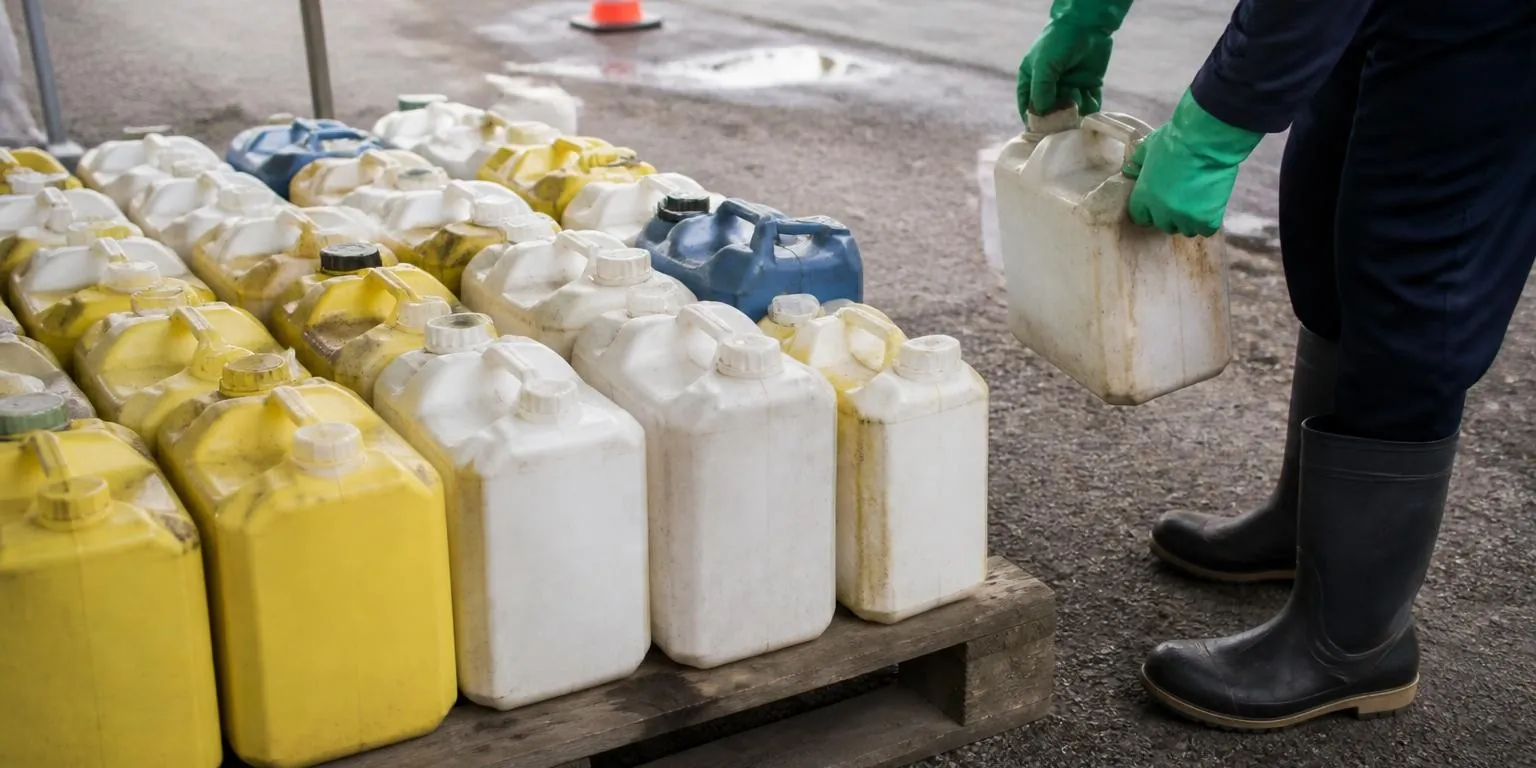
Pesticide waste is any material with any concentration of pesticide that is no longer desirable. That covers rinse material, leftover spray solutions, excess product and canceled or suspended pesticides. For leftovers, start by using up small amounts on the labeled site. You cannot pour pesticides down the drain, because drain disposal sends them into sewers and waterways. Empty containers need an immediate triple rinse or pressure rinse. Several laws govern disposal, and storage and transport have their own steps. Keep products in their original containers with the labels attached for both. Avoiding leftovers starts with identifying the pest before purchase.
What Counts as Pesticide Waste?
Pesticide waste is any material with any concentration of pesticide that counts as no longer desirable. Pesticide waste covers rinse material from containers and spray equipment, leftover spray solutions, excess pesticides and canceled or suspended pesticides. The Colorado Environmental Pesticide Education Program gave this definition in 2006.
Household pesticide waste means empty containers, leftover mixture from an earlier application and unused product in the original container. Household pesticide products include insect sprays, flea products, mothballs, rodent poisons, weed killers and wood preservatives.
Pesticide waste starts with a decision. Any material containing any concentration of a pesticide becomes a solid waste once its holder decides to discard it. The Resource Conservation and Recovery Act governs the management and disposal of hazardous wastes, including pesticides.
How Do You Dispose of Leftover Pesticides?
To dispose of leftover pesticides, start with using up small amounts on the labeled site. Offer leftover pesticides you cannot use to a neighbor with the same pest problem. Follow the label storage and disposal statement for any product that remains. Take the remainder to a household hazardous waste collection.
Leftover pesticide in small amounts is used up by applying it according to the label directions. Neighbors with a similar pest control problem may be able to use up unwanted product. State and local laws can be stricter than federal requirements.
Unusable leftover pesticide needs the label disposal instructions first, and then a household hazardous waste program. Leftover pesticide in the container is disposed of as household hazardous waste. Many communities have collection programs for household hazardous waste to reduce the potential harm of these chemicals.
Leftover pesticide waits in a large plastic bag in a cool, dry place until the next collection day. Unwanted product is stored safely and disposed of as soon as possible.
Restricted use pesticides must not go to people who are not certified to apply them.
In 2019, Iowa State University Extension and Outreach noted that farms count as a business. Federal limits apply to the quantity a farm brings to a regional collection center.
Where Can You Take Unwanted Pesticides?
You can take unwanted pesticides to household hazardous waste collection sites, regional collection centers or commercial waste haulers. State ChemSweep programs for licensed applicators take unwanted pesticides, and state pesticide clean sweep events do too. Local solid waste, environmental or health agencies know whether a community has a household hazardous waste collection program. Earth 911 at 1-800-CLEANUP lists local collection options.
In 2026, the Pennsylvania Department of Agriculture stated that CHEMSWEEP is not a homeowner program. Homeowners use the household hazardous waste program instead. The household hazardous waste program sometimes partners with CHEMSWEEP to take pesticides. Local environmental, health or solid waste agencies run household hazardous waste collections.
Regional collection centers accept pesticides from farms in almost all cases, by appointment and for a fee. Commercial waste haulers offer another route for excess pesticide product.
How Does a Pesticide Clean Sweep Program Work?
A pesticide clean sweep program works as a scheduled collection where participants register products and hand them to a contractor. The Illinois Clean Sweep program is paid for through a federal grant and runs in rotating counties depending on funds. The state conducts these collections for county residents with the Illinois Department of Public Health.
In 2024, the Illinois Department of Agriculture required registration of products before the collection date. The contractor works from that registration. The state, not the participant, assumes liability for the proper disposal of the materials collected.
2500 pounds of solid and 300 gallons of liquid pesticide is the South Carolina limit per participant at no charge. The event took outdated or unwanted pesticides but refused rinsate and empty containers. Pennsylvania CHEMSWEEP covers the first 2,000 pounds per participant.
Pennsylvania CHEMSWEEP incinerates most waste pesticides it collects. Hazardous waste landfills take the rest.
Can You Pour Pesticides Down the Drain?
No. You cannot pour pesticides down the drain, because drain disposal sends pesticides into sewers and waterways. Wastewater treatment cannot remove all pesticides, and pesticides must never go down the sink, toilet, sewer or street drain. Household hazardous waste mismanagement includes pouring products down the drain, on the ground or into storm sewers.
A 2013 study by Julian Campo surveyed more than 40 pesticides in 16 sewage treatment plants. The plants sat in four Mediterranean river basins in Spain. Most pesticides were only partially eliminated by secondary and tertiary treatment. The plants can therefore be a focal point of contamination to rivers.
Waterway contamination harms fish, plants and other living things when pesticides reach waterways. Many municipal drinking water and wastewater treatment systems are not equipped to remove all pesticides.
Rinse water goes only to the labeled site and never into any drain.
Buried or dumped pesticide is no alternative, because dumping or burying can contaminate soil or groundwater for decades. The Comprehensive Environmental Response, Compensation, and Liability Act provides a federal Superfund to clean up abandoned hazardous waste sites.
How Do You Dispose of Empty Pesticide Containers?
To dispose of empty pesticide containers, start with rinsing each container immediately by triple rinse or pressure rinse. Discard the rinsed container as the label directs. Never reuse empty pesticide containers, because residues can contaminate the new contents and cause serious harm.
A drip-drained container may still hold as much as 3 percent of its contents. Under federal law, a pesticide container is not empty until it has been properly rinsed. Properly rinsed containers can be handled and disposed of as non-hazardous solid waste. The RCRA empty container rule exempts hazardous waste remaining in an empty container from parts 261 through 268.
A 2025 study by Georgios Garbounis found triple rinsing removed 68.3% to 99.9% of liquid contents of 15 active substances. The test covered 56 waste plastic containers. Triple rinsing may therefore not always bring contents below hazard limits.
Andressa Sbano of Rio de Janeiro State University found that measurable 2,4-D residues may persist after triple rinsing. Residues persist particularly in small HDPE containers and with more viscous formulations.
How Do You Triple Rinse a Pesticide Container?
To triple rinse a pesticide container, follow the 6 steps below. Triple rinse means filling an emptied container with clean water, shaking it and pouring the rinse into the spray tank. Rinse the container as soon as you empty it, while it is still moist inside.
- Drain the emptied container into the sprayer for at least 30 seconds, so the container starts the rinse as empty as possible.
- Fill the container about 20 percent full with clean water and cap it, which leaves room for the water to move.
- Shake the container so the water reaches all inside surfaces.
- Pour the rinse water into the spray tank and drain the container for 30 seconds, so the rinse goes to use.
- Repeat the rinse two more times.
- Dispose of the rinsed container as the label directs.
Pressure rinsing needs a nozzle on a clean water source of at least 40 psi. It runs for at least 30 seconds. Triple hand rinsing takes 4 to 9 minutes per container versus 1 to 2 minutes for pressure rinsing. Delaware sets the rinse volume at 10% of container capacity.
99.99 percent removal of each active ingredient is the federal standard for nonrefillable containers of dilutable products. The standard covers rigid containers of 5 gallons or less.
Andressa Sbano found in 2026 that small HDPE containers and viscous formulations keep more 2,4-D residue.
Can Empty Pesticide Containers Be Recycled or Thrown Away?
It depends. Household pesticide containers are not recycled unless the program expressly accepts them. Empty pesticide containers can be thrown away after proper rinsing. Rinsed containers may go to a landfill or an accepting recycling program, and state rules and the label decide.
Home and garden containers wrapped in several layers of paper may go through routine municipal solid waste disposal in Delaware. Triple rinsed commercial containers go to a sanitary landfill or an accepted recycling program there. Federal rules at 40 CFR part 261 point such containers to a municipal solid waste landfill. A hazardous waste landfill is the other federal option.
Georgios Garbounis titled a 2025 study Triple water rinsing does not always render waste plastic pesticide containers non-hazardous waste. Rinsing quality therefore still matters before any container leaves the farm or home.
California allows rinsed empty containers of 5 gallons or less in the trash. Colorado treats triple rinsed liquid containers as no longer hazardous waste, usually trash in a sanitary landfill. Properly rinsed containers can be handled as non-hazardous solid waste.
Household pesticide containers are not accepted by free container recycling through the Ag Container Recycling Council. Pesticide containers are not recycled unless the program expressly accepts them.
How Do You Dispose of Aerosol Cans and Pesticide Bags?
To dispose of aerosol cans and pesticide bags, start with spraying the remaining contents on the labeled site. Open pesticide bags and boxes and empty them into the spray tank. Dispose of the empty pesticide container as the label directs.
In 2021, Clemson Cooperative Extension said never to puncture or burn a pressurized or aerosol container, because it could explode.
Pesticide bag contents go into the spray tank. The bag is cut open to remove the remaining product. Both ends of a dry formulation box or bag are opened to remove remaining pesticide and prevent reuse. Containers that cannot be rinsed, such as aerosol cans and dry product bags, are emptied instead.
Universal waste rules list aerosol cans among five categories of materials managed as universal wastes. The five categories are batteries, pesticides, mercury-containing equipment, lamps and aerosol cans. Materials managed as universal waste can be stored for a year and need no manifest or hazardous waste transporter.
How Do You Dispose of Leftover Spray Mix and Rinse Water?
To dispose of leftover spray mix and rinse water, start with limiting spray tank volume to the amount needed. Apply excess spray mixture to the labeled site at the labeled rate. Add rinsate to the next batch of the same product. Keep rinse water out of drains, septic systems, ditches and streams.
Excess spray mixture stays out of the sprayer, because stored mixture can deteriorate sprayer parts. Never store the excess mixture in sprayers for later use.
Rinsate is the rinse water from containers and sprayers. Use rinsate immediately on a labeled site. Store it in a clearly marked jug for the next spray with that pesticide. Rinse water is applied according to label directions, only where the pesticide was intended to be used.
Julian Campo reported in the Journal of Hazardous Materials that sewage treatment plants only partially remove most pesticides. Effluent can then contaminate rivers. Rinse water is not buried or discharged to the ground, septic systems, ditches or streams.
How Do You Dispose of Banned or Cancelled Pesticides?
To dispose of banned or cancelled pesticides, start with checking whether the registrant runs a recall program. Confirm whether the label still allows use of cancelled pesticide until supplies run out. Take the product to a household hazardous waste or ChemSweep collection. Contact a commercial waste hauler if no program exists.
A recall program may let the registrant collect recently canceled pesticide. Most older pesticides may legally be used up under the existing label. A stop use order at cancellation is the exception. State collection programs such as ChemSweep take unused, banned or outdated pesticides. In 2025, Penn State Extension noted that the household hazardous waste program sometimes partners with CHEMSWEEP to take pesticides.
Cancelled pesticide that is no longer legal to apply can go to a commercial waste hauler or collector.
Chlordane, DDT, chlorpyrifos and diazinon are no longer sold, so households take them to household hazardous waste collection. Soil contaminated with chlordane from pesticide application is a hazardous waste only if excavated for disposal and characteristic.
Universal waste rules for pesticides apply to recalls, suspensions, cancellations and waste pesticide collection programs. Universal waste regulations streamline the hazardous waste standards for categories commonly generated by many establishments. Recalled stock covered by a recall program may be managed as universal waste under 40 CFR 273.3.
What Laws Govern Pesticide Disposal?
Several laws govern pesticide disposal. The Federal Insecticide, Fungicide, and Rodenticide Act governs the sale, distribution and use of pesticides in the United States. Key laws include:
- Label disposal directions: Federal law (FIFRA) and state law require pesticide applicators to rinse all empty pesticide containers properly before disposal. The label carries the storage and disposal statement.
- Resource Conservation and Recovery Act hazardous waste rules: Pesticides are regulated under FIFRA until they are disposed, after which the Resource Conservation and Recovery Act regulates them as hazardous waste or non-hazardous solid waste. Excess pesticide and rinsates that cannot be used must be disposed of as hazardous waste unless an exemption applies.
- Universal waste rule: This rule covers recalled, suspended or cancelled pesticides and stock from waste pesticide collection programs. Clean sweep collections therefore handle them more easily.
- Container residue standards: Nonrefillable container standards in 40 CFR Part 165 set the 99.99 percent residue removal requirement for dilutable products.
- State and local laws: State and local laws may be stricter than the federal label requirements. Delaware is one example.
In 2023, the Delaware Department of Agriculture prohibited disposal inconsistent with the label, open dumping and open burning.
California makes it illegal to put any amount of unused pesticide in the trash, regardless of the label. The California Department of Pesticide Regulation takes enforcement actions to address violations of pesticide laws and regulations.
Do Household and Farm Disposal Rules Differ?
Yes. Household disposal rules differ from farm disposal rules in the hazardous waste exemption, collection program eligibility and quantity limits. Household wastes, including homeowner pesticides, are exempt from Colorado hazardous waste regulations.
| Attribute | Household disposal | Farm and commercial disposal |
|---|---|---|
| Hazardous waste exemption | Homeowner pesticides are exempt in Colorado | A farmer who triple rinses and disposes of residues on the farm per the label is exempt in Colorado |
| Collection program eligibility | Homeowners use household hazardous waste programs | Dealers, commercial applicators and manufacturers were excluded from the South Carolina event |
| Quantity limits | None stated for households | Federal limits apply to the quantity a farm brings to a collection center |
A farmer who triple rinses containers and disposes of residues per the label is exempt in Colorado.
Farms count as a business, so federal limits apply to the quantity a farm brings to a collection center. In 2025, the South Carolina Department of Agriculture excluded dealers, commercial applicators and manufacturers from its collection event.
How Should You Store Pesticides Before Disposal?
To store pesticides before disposal, you should start with keeping unwanted pesticide in its original container with the label intact. Place a leaking container inside a larger leak-proof container labeled with the contents. Store pesticides out of reach of children and pets, away from heat and away from the house if possible. Keep pesticides away from food and feed. Write an inventory and tape down loose labels.
Stored pesticide never shares space with food, seed, fertilizers or veterinary supplies. Livestock poisonings have followed contaminated feed stored with pesticides. Hazardous products are never kept in food containers. Incompatible products might react, ignite or explode, and contaminated household hazardous waste might become unrecyclable.
A written pesticide inventory and tape over labels keep waste pesticide identifiable for disposal.
A 2007 study by Flemming Konradsen gave locked storage boxes to 200 households in rural Sri Lanka. Seven months later, 141 households (82%) kept pesticides under lock, versus 3 households (2%) at baseline. Households keeping pesticides safe from children rose from 64% to 89%.
A 2013 study by Ophir Lavon found that neglected storage and inadequate practice lead to dangerous exposure to insecticides. Intoxication risk is higher where insecticides sit close to families and children.
Stored pesticide in 55-gallon drums or smaller portable containers falls under the storage instructions on the label. Federal regulators handle this storage through those instructions.
How Do You Transport Pesticides to a Disposal Site?
To transport pesticides to a disposal site, start with keeping the pesticides in their original containers with the labels attached. Line the transport area or use a plastic bin to hold the pesticides. Secure and cover the load in an open vehicle. Keep pesticides out of the passenger compartment. Drive straight to the collection site.
In 2026, the National Pesticide Information Center directed that pesticides never ride in the passenger compartment of a vehicle. Transport keeps pesticides away from groceries, including food for animals.
Ophir Lavon reported in Harefuah in 2013 that insecticides near families and children raise the chance of intoxication. The load therefore stays away from people.
How Can You Avoid Leftover Pesticides?
To avoid leftover pesticides, start with identifying the pest before purchase. Calculate how much product the job needs from the product label. Buy the smallest suitable size. Mix only what you need that day.
Purchase only the amount needed this season. Mixing only what is needed that day follows the same advice. Ophir Lavon wrote in Harefuah that neglected storage leads to dangerous exposure to insecticides.
The product label states how much a container makes. At 1 teaspoon per gallon, a pint makes 96 gallons of spray.
Integrated Pest Management is an effective and environmentally sensitive approach to pest management built on common-sense practices. Identifying the pest and practicing integrated pest management reduce the need for pesticides.
Alternatives to pesticides include swatters, sanitation, resistant varieties and barriers. These options can remove the need for a pesticide.
Storage life reaches several years for many chemical pesticides stored cool, dry and frost-free.